Sport Society of Nälkälänmäki Publication 2/1999 8.8.1999
Authors: Veterans of Mantsu
THE RULES OF KILLI
Introduction:
Killi is a game that originates in Finland, where kids play it in ice hockey rinks when they don’t have enough other kids to play real ice hockey with, or when they are just hanging around. Killi has different variations that all develop the skills needed in ice hockey. For instance, all the Wall-Killi variations develop players’ passing accuracy where Goal-Killi teaches how the puck bounces when it hits different parts of a goal with different speeds. Point- Killi improves player’s shooting accuracy. Both Rink-Killi and Long-Killi train players’ passing accuracy as well as their power control.
How to play Killi,
Both players need an ice hockey stick and puck in order to play Killi. Skates are optional. The only strict rule of the game is -- it actually applies everywhere -- that all the conflict situations should be resolved by a mutual agreement. All the other rules can be modified and agreed upon by players. The above feature of Killi trains young players how to agree upon and apply mutual rules, both important skills in life.
Wall-Killi, basic version:
Two players can play the game. They have to define a playing area on a rink wall, or any wall before they can start a game. The area can be for instance:
- A rink wall with the width of one wall
section
- A rink wall between two blue lines
- A rink wall between the red line and one of the blue lines
- A rink wall between the red line and a goal line.
In the beginning, players agree on who will start the game and how many points the winner needs for a victory. The first player starts the game by shooting his/her puck to the rink so that the puck hits the defined target area on the wall side. The second player then shoots his/her puck trying to hit the first player’s puck on the ice. However, the second player’s puck can touch the other player’s puck only after it has first bounced back from the target area on the wall.
-The second player always gets a point when s/he hits the first player’s puck after a bounc from the target area or his/her opponent misses the target area on his/her turn.
-The first player always gets a point when his/her opponent’s puck touches his/her puck before hitting the target area or his/her opponent misses the target area on his/her turn.
Players continue the game with the above rules, changing the shooting order until the winner has enough points for a victory.
Wall -Killi, advanced version:
This game has the same principle as the basic version of the game. In this version both players shoot their pucks from the spot where they were moved by the hitting opponent’s puck. The idea of the game is to hit the opponent’s puck so that it slides into the position where the opponent, on his/her turn, would have difficulties to hit the target area on the wall. As a player’s shooting angle against the wall decreases, it becomes more difficult to shoot the puck so that it hits the target area on the wall. The player who, misses the target area on the wall first, loses the game.
Wall -Killi
Goal-Killi
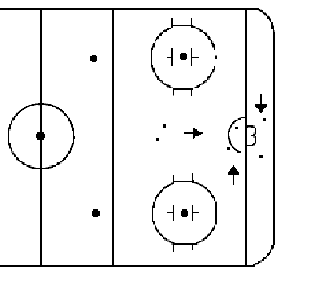
Goal-Killi also has the same principle as the basic version of Wall-Killi. However, in this game, a goal is used as a target area instead of the defined area on the rink wall. The goal can be hit from any direction and the puck is allowed to stay in the goal net after the shot. Those goals with steel wire nets make the game more interesting than those with rope nets, because players can utilize the spring effect of the steel wire net. Points are calculated the same way as in the basic version of Wall-Killi.
Point-Killi
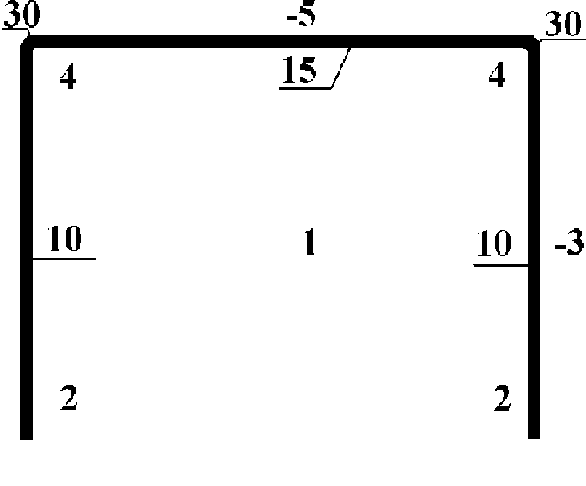
Several players can play Point-Killi at the same time. In this game, players try to hit different parts of the goal with their pucks instead of the other player’s pucks as in Wall-Killi. Shooting always happens behind a defined spot or a line on the ice. The idea of the game is that a player gets a different amount of points when s/he hits different parts of the goal. The points are adjusted to players’ scores after each full round of shooting. The winner of the game is the player whose score first equals the pre-agreed winning score. If the player’s score is higher than the winning score, s/he can try to reduce his/her score by hitting parts that give negative points. Players can agree upon point values for different parts of the goal, but the following is a recommendation for a point system:
The goal net or the bottom frame 1 pt
Bottom corners 2 pts
Upper corners 4 pts
Side posts 10 pts
The upper post 15 pts
The corner of a side post and the upper post 30 pts
Hitting wide (below the height of upper post) -3 pts
Hitting over the goal -5 pts
Goal and Point -Killi
Rink-Killi
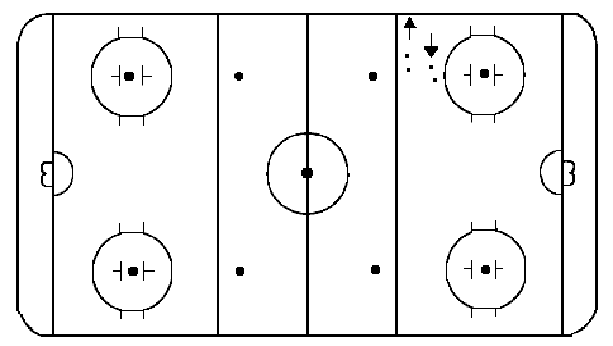
Rink-Killi requires the whole ice hockey rink as a playing area and it has similar principle as golf. The idea of the game is to go around the rink so that players’ puck hits all the face-off spots on the ice in the pre-agreed order. One game can include as many rounds as players agree to in the beginning. The game always starts from an agreed B-face-off spot and ends at an A-face-off spot. If the players’ puck goes outside of circle around the spot or misses the spot completely, s/he loses his/her turn and has to try to hit the same spot again on the next time. The winner of the game is the player who finishes his/her round(s) with the least amount of shots.
Long-Killi
Long Killi is a combination of Wall-Killi and Rink-Killi. The game requires whole rink as a playing area. At first, the two players decide on a starting point of the game. The player who starts the game shoots his/her puck to a pre-agreed direction. The puck doesn’t need to touch any specific spot or area. The second player shoots from the same spot and tries to hit the first player’s puck with his/her own. Hitting can happen after a straight shot or a bounce from a wall for instance. The second player gets a point after a successful shot. After both players have shot, they will change the starting order and may change the starting point too.